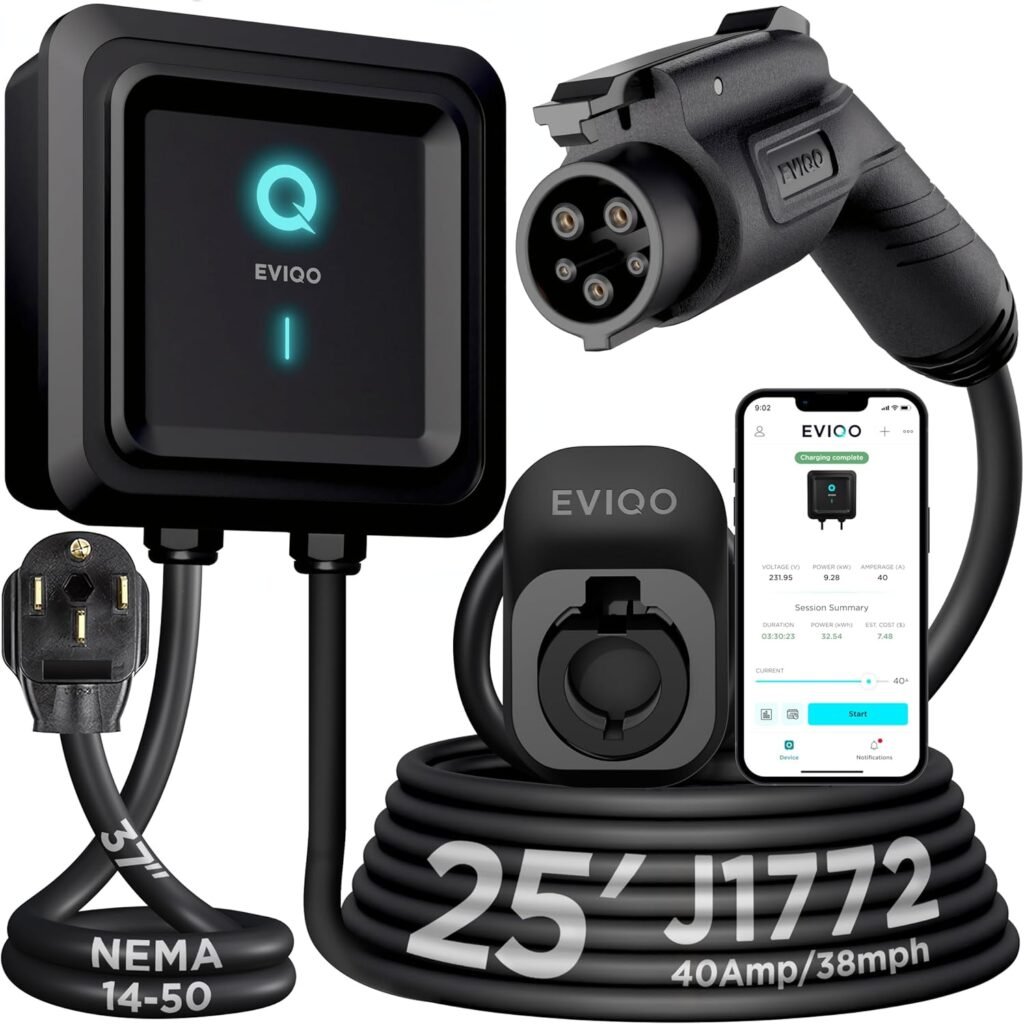
Whether you have an electric car for many years or are waiting for your first EV to leave the factory, you should consider installing a Level 2 charger for your home.
Newer EVs come with a Level 1 charger that can be stored in a trunk (or front trunk) and plugged into a standard outlet. But for the fastest charging EVs at home, Level 2 chargers are the best choice, providing more than four times the mileage per charge time.
After 58 hours of research and 95 hours of testing, the Emporia Level 2 EV charger (J1772 version) for EVs with J1772 ports has been developed for Tesla and Tesla. We concluded that the Emporia Level 2 EV charger (NACS version) is the best home charger for EVs equipped with the j3400 connector (North American charging standard: NACS).
Both specifications are high power, easy to use, and come with a long cord. And thanks to the streamlined shape, the occupied space in the garage is also minimized.
Emporia Level 2 EV Charger (J1772 version)
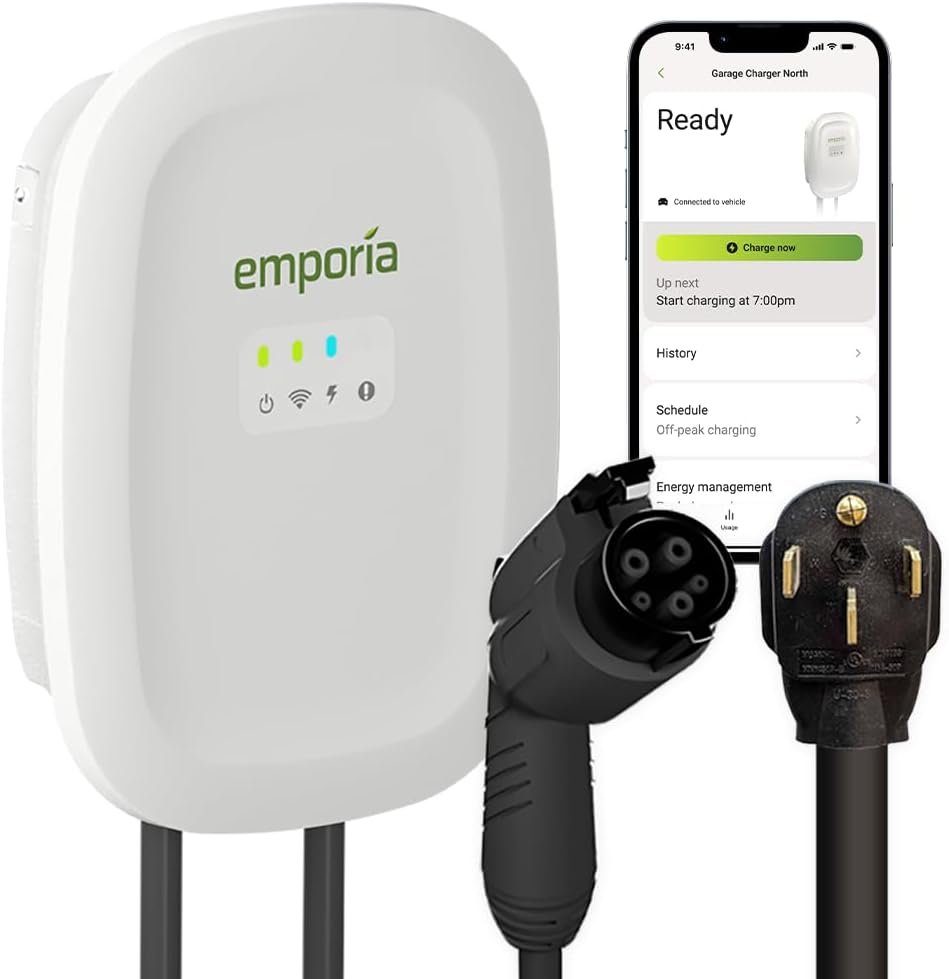
Emporia electric vehicle chargers offer charging speeds of up to 46 miles per hour with hard-wired connections (48 amps – up to 9 times faster than standard wall outlets) or up to 38 miles per hour with NEMA plugs (40 amps).
It is pre-configured up to 40A with NEMA type 14-50P according to NEC section 625.17 2017 or switched to hardwired connection up to 48A. For optimal safety and performance, installation by a specialist is recommended.
It is UL Certified, ENERGY STAR Certified. Meets strict standards (NEC 625, SAE J1772, UL 817, UL 991, UL 2231, UL 2251, UL 2594). Access real-time energy data with a 2.4GHz WiFi connection and manage charging from your mobile device. Schedule charging sessions to optimize power rates and performance.
All North American EVs, including Tesla, Chevrolet Bolt, VW ID 4, Nissan LEAF, Ford Mustang Mach E, IONIQ 5/6, BMW i3, i4, iX, Audi, and G-Prangler 4xe, are equipped with a secure SAE J1772 connector.
EVIQO Level 2 EV Charger
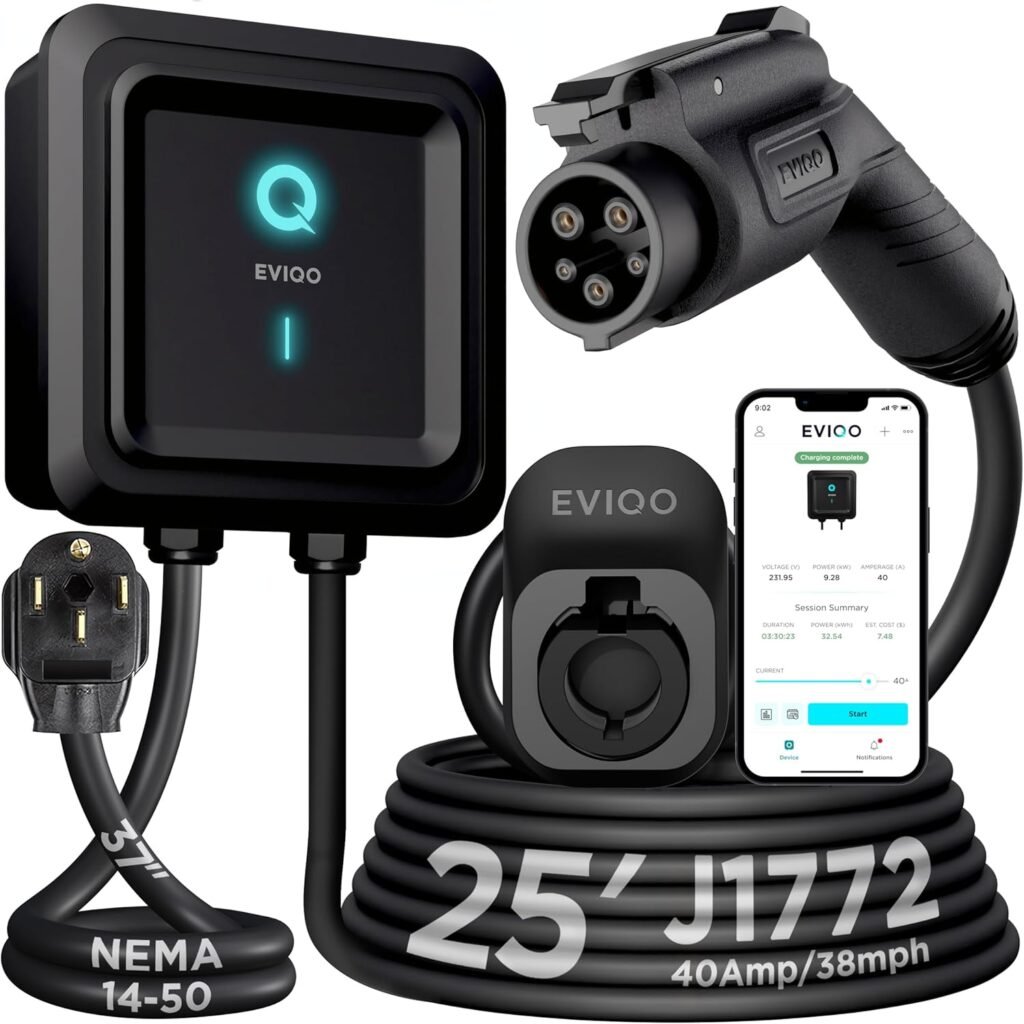
8x faster than basic portable EV charger. 9.6kW – Up to 38 miles per hour. The home level 2 EV charger requires 240V NEMA 14-50 outlets (40A or 50A circuit rating). EVIQO electric vehicle chargers are eligible for subsidies and preferential treatment (including a 30% federal tax credit). The steel plate shield on the main board protects the inside of the charging station. The external reset button solves the problem in seconds. NEMA 4/IP66 Housing Resistant to Rain, Snow, Sleet, High Temperatures and Dust.
Advanced Wi-Fi ensures EVIQO Level 2 Charger is always connected in the garage and basement. The app can control charging start/stop, 6-40A current setting in 1A increments, charging schedule setting (support off-peak charging), reminder reception, and consumption/cost tracking. Remote OTA firmware update (2.4GHz)
Reach anywhere with a 25 foot (approx. 7.6m) EV charging cord. Supports all EV/PHEVs in North America. Sturdy, fully rubber J1772 connector. Works as a Tesla Home Charger with NACS adapter (sold separately)
EVSE Level 2 charger that just takes you out of the box and plugs in. No electrician required (wall mount kit and guide included with level 2 charger)
ChargePoint HomeFlex Level 2 EV Charger J1772
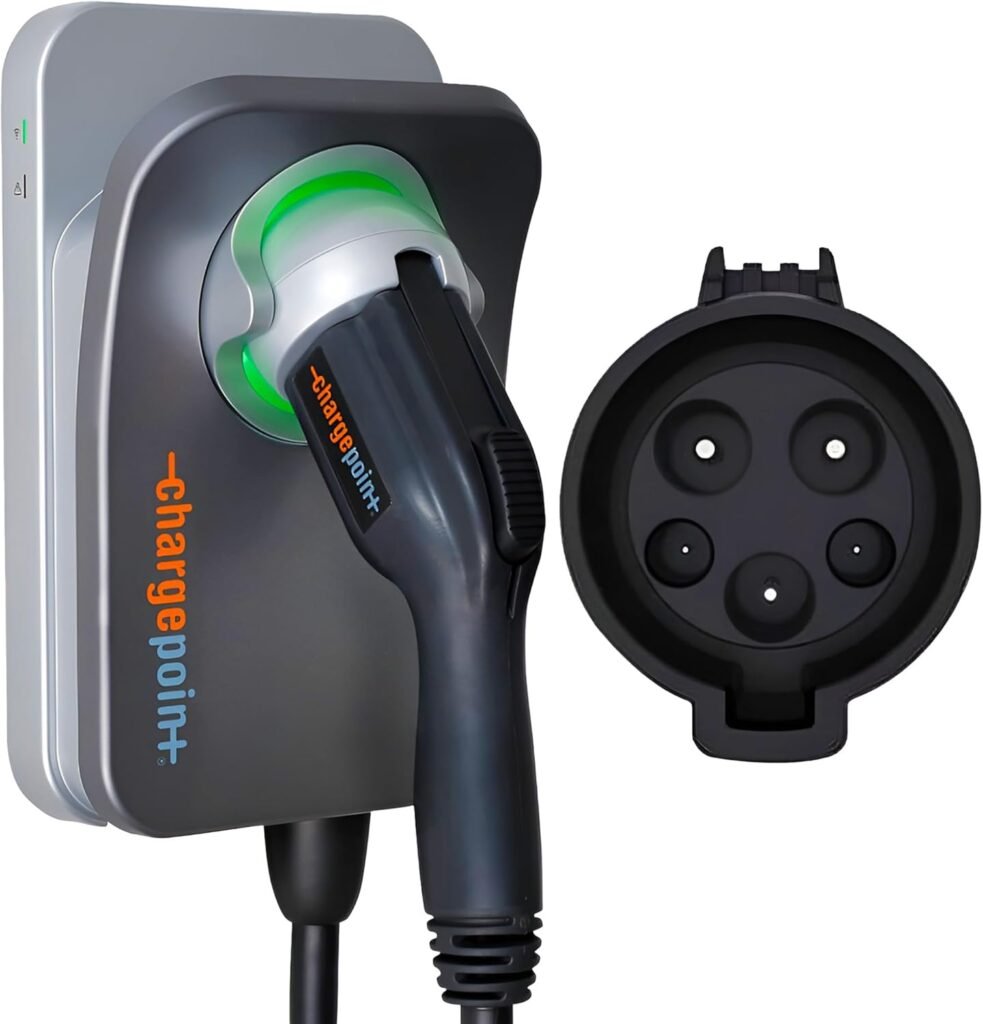
ChargePoint offers reliable and flexible EV charging stations for homes, businesses and fleets. 24/7 support and access to hundreds of thousands of charging locations across North America.
It control electric vehicle chargers, manage reminders, connect to smart home devices, find charging spots, get data and charging information, and access the latest features with the easy-to-use ChargePoint mobile WiFi connection is required to troubleshoot certain features or connectivity issues. More than 274,000 locations in North America and Europe, and more than 565,000 roaming partner stations. ChargePoint networks accompany you everywhere.
UL-certified EV charger for safe home charging. Can be installed indoors and outdoors by electricians. Cold-resistant cable included. Up to 9 times the charging speed of 110 V outlet ratio (equivalent to about 60 km/h). All EVs except Tesla are supported with a J1772 connector (20A/80A circuit required). Tesla EV requires an adapter.
Who is this for
If you are considering purchasing an EV and want to achieve the fastest charging at home, or already own an EV and are considering upgrading from a slower Level 1 charger to a faster Level 2 charger, this guide is for you.
The lifestyle, needs and priorities of EV drivers vary greatly, but the introduction of high-performance home chargers is often a valuable investment. According to the U.S. Department of Transportation, charging a Level 1 charger from empty to 80% takes 40 to 50 hours, while charging a Level 2 charger takes only 4 to 10 hours.
Even if the mileage is low and a night charge is sufficient, it is worth considering the installation of a home charger that can quickly charge in the event of an unexpected disaster such as a forest fire or flash flood.
Level 2 chargers not only charge faster, but often have features not available with the chargers that come with the EV, such as:
Option to route the charger directly to your home electrical system
Long cord that can cross two garages or carports
A smartphone app that complements EV apps and tracks battery life, charging time, and more
weather-resistant enclosure to protect against weather
As with all home improvement projects, upgrading EV charging equipment costs money. In addition to the battery charger itself, the cost of installation by a specialist must be estimated at about $550 to $1,400. You can buy a plug-in model to avoid this barrier, but if you don’t have a 240V outlet in the parking space (mainly for RVs and electric hobs), it will cost you at least a few hundred dollars to install and you will be able to use the high current of the Level 2 charger.
The good news is that many federal, state, and local programs offer subsidies and other incentives to help recoup the cost of EVs. If you live in a rented house and are not sure if your lease allows you to install a Level 2 charger, check the “Right to Charge” laws of your state. Similarly, if you own a home or a rental property, the U.S. Department of Energy has a wealth of resources on installing EV chargers.
EV charging at home
If you’re an electric car owner who wants to start charging at home, here’s what you need to know.
EV charge level:
Level 1: 120V AC (standard household outlet) charged. The power output is about 1 kilowatt. It takes a few days to charge.
Level 2: 240V AC charged. The output is usually 6 to 19 kilowatts. Charge mid-size battery EVs overnight.
Level 3/DC quick charger: Uses 400 or 800 volts of direct current electricity with output of 50-350 kilowatts. It can charge EV batteries from 10% to 90% in just 30 minutes. It is installed in public areas, but it is unrealistic for home use due to its high cost.
Output:
This is the amount of charge power supplied to the EV, measured in kilowatt units. (The amperage of the current flowing through the voltage of the electrical circuit is multiplied by the amperage of the power in watts, 1000 watts is equivalent to 1 kilowatt.) Example: If a 240-volt outlet carries a 32-amp current, the output power is 7.7 kilowatts.)
Connector type:
Connectors are required to connect charging devices to electric vehicles (EVs). For home chargers like those listed here, there are two main standards to watch out for: the J1772 standard and Tesla’s North American charging standard (NACS or J3400). Fortunately, adapters that switch between connector types are widely available, so you don’t have to be limited to the vehicle’s connection method.
Cost of installation:
The cost varies greatly depending on whether there is enough spare power capacity. If the capacity is sufficient, new wiring can be drawn for several hundred dollars. In the case of insufficient capacity, it can cost thousands of dollars to add capacity to the electrical system of the house. Details are described below.
EV Charging Tax Incentives:
A comprehensive inflation control law has reinstated a federal tax credit of 30% of total costs (up to $1,000). Electrical upgrades, wiring work, and the charger itself are all eligible for this exemption. With the passing of the so-called Big Beautiful Building, this measure is scheduled to expire on June 30, 2026.
Things to check before buying a home EV charger
Home Circuit Output
Your home electrical circuit has a maximum allowable current. Since EV charging requires an electric current of 24 to 80 amps, it is important to check the capacity that the home can handle in addition to the current electricity usage such as heating, cooling, oven, and clothes dryer.
Check the main fuse of the breaker box and check the rated current. This is the maximum allowable current in the house before the main breaker falls. If you have a service capacity of 150 amps or 200 amps or more, you may be able to afford to add charging equipment without upgrades. However, it is necessary to measure the peak power usage of the house and consult with an electrician. A 40A or 50A circuit is recommended because most EVs can be charged overnight at a lower cost. A certified electrician is mandatory to check the circuit capacity of the house and install the necessary equipment and upgrades.
Some EV charging devices, such as this Emporia unit, have load management features that constantly monitor the power output of the entire house and automatically reduce the charging current if necessary to prevent exceeding the capacity of the house.
charge rate
The charge rate is expressed in kilowatt units of power (voltage × current = power, 1000 watts = 1 kilowatt). This allows for the estimation of the charge time. When charging at 6 kilowatts, if the battery capacity of the EV is 60.0 kWh, it takes about 10 hours from empty to full charge. (The charge speed is actually slightly longer as the charge loss or the battery approaches 100%.) The charge speed is affected by three factors (the output of the home circuit, the charging equipment, and the vehicle charger) and is limited to the lowest of these values.
Wi-Fi Connectivity
If you want to understand the power usage and cost of an EV, a home charger with Wi-Fi connectivity is recommended. This allows you to monitor the charging status, receive notifications, and control the charger through the app.
variation
Most EV chargers offer different variations to suit your needs. These variants (fixed wiring or plug type, different output capability, different connector types, different cord lengths) are usually offered at slightly different prices. Check all the options for each manufacturer.
Suitable for outdoor installation
If you want to install an EV charger outdoors, you can install it without any problems. Each charging unit tested by us is rated for outdoor installation according to the National Electrical Manufacturers Association (NEMA) or Dust and Water Resistance (IP) standards.